
Validating AI Data Centre Infrastructure:
Thermal Performance Testing with the LBR-240
Why Thermal Validation Matters for Next-Generation Data Centres
High-density compute environments and AI deployment demands are pushing modern thermal management beyond the capabilities of traditional air cooling. Facility operators are rapidly adopting direct-to-chip and immersion liquid cooling infrastructure to manage intense heat loads. However, simply installing liquid cooling piping and heat exchangers is not sufficient. Before high-value server racks are powered up, the underlying liquid cooling loops must be tested, validated, and proven to handle extreme thermal stress under real-world operating conditions.
Without rigorous testing, subtle design oversights, flow distribution imbalances, or heat exchanger inefficiencies remain hidden until live server hardware is exposed to thermal risk.
Seeing the Temperature Differential in Action
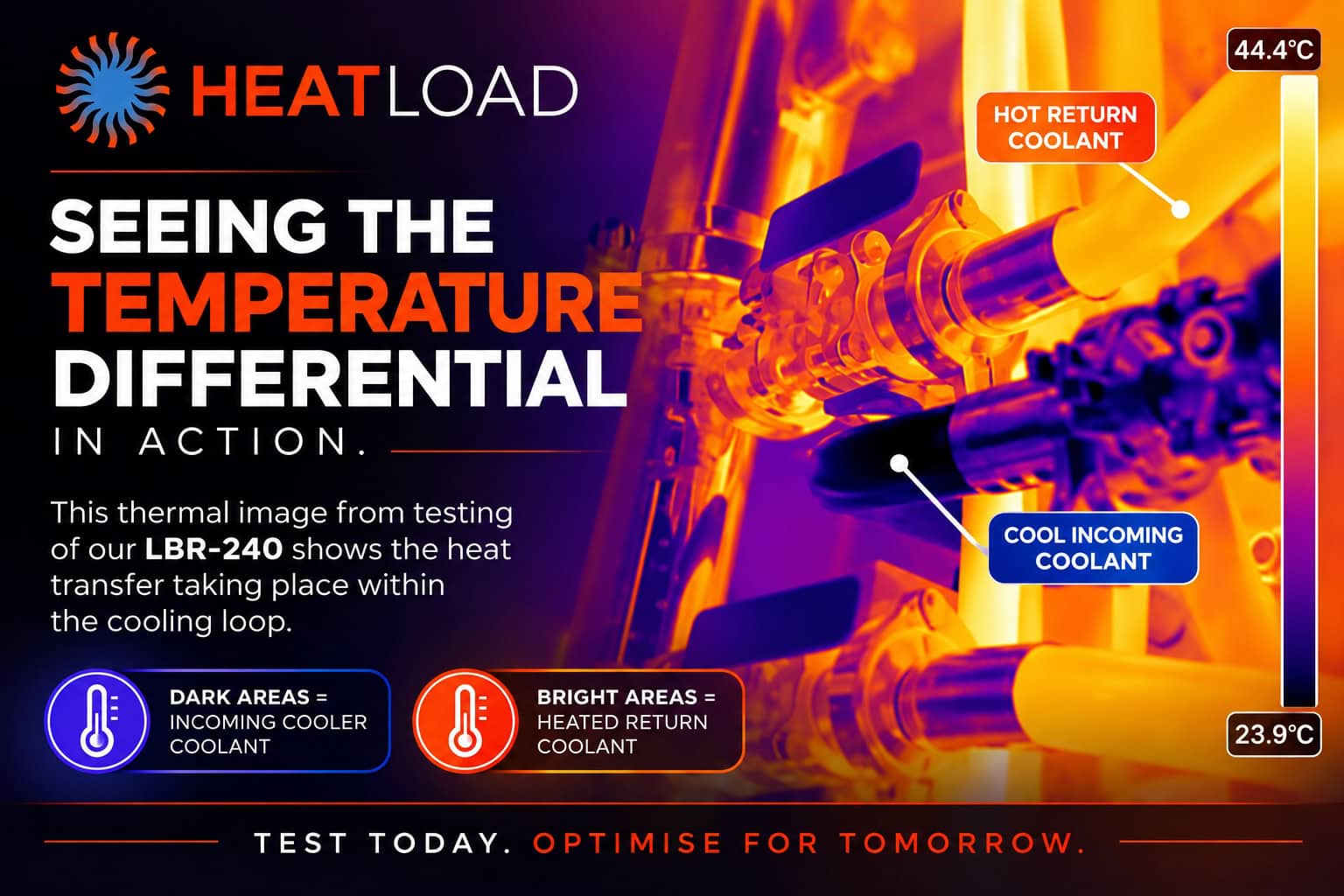
Thermal imaging provides clear visual evidence of how heat transfer behaves within a fluid circuit. During recent operational testing of our LBR-240 Liquid Cooled Load Bank, thermal imaging captured the precise dynamics of the cooling loop under load.
In the thermal scan, distinct temperature zones illustrate the heat absorption process:
- Dark Areas (23.9°C): Represent incoming cooler coolant entering the unit before thermal application.
- Bright Areas (44.4°C): Highlight the heated return coolant after absorbing thermal energy from the load bank.
As coolant passes through the LBR-240, the system applies a controlled, precise thermal load, raising fluid temperature in a predictable manner. This temperature differential allows commissioning engineers to evaluate fluid flow dynamics, verify heat rejection rates, and confirm that distribution units perform safely under full operational load.
Precise Simulation with Server Emulators and Load Banks
Relying on live, mission-critical AI servers to perform initial facility commissioning poses severe operational and financial risks. HeatLoad’s server emulators and liquid-cooled load banks eliminate this risk by acting as controllable, safe heat sources during facility startup.
The LBR-240 simulates high-density thermal loads, allowing data centre operators to:
- Validate pipework integrity, valve operation, and pressure stability across the cooling circuit.
- Verify secondary fluid network capacities and heat exchanger thermal efficiency.
- Fine-tune control systems, pump speeds, and automated failover protocols without risking actual IT assets.
- Guarantee that cooling infrastructure meets SLA specifications prior to server integration.
From Air to Liquid: Continuous Evolution in Data Centre Commissioning
Data centre infrastructure is evolving rapidly, moving from traditional air-chilled facilities to hybrid and fully liquid-cooled deployments. HeatLoad continues to pioneer testing solutions for every stage of this transition. By providing scalable air load banks and liquid cooling load bank solutions, we help facility managers and commissioning teams de-risk deployments.

